In 2007 Ban Ya bought his first skateboard off a supermarket shelf in Shandong. It was a ¥90 no-name board, the cheap kind supermarkets sell as a toy, and it snapped within a month.
By then he was hooked.
He grew up in Handan, a steel town in the south of Hebei, and dropped out of school in his second year of high school. After that he took the jobs open to a teenager without a diploma. He hauled bricks on a construction site. He cooked in a restaurant kitchen for six months. He trained in acupuncture and massage.
He skated through all of it.
In Beijing he got a job as a security guard at the library of Peking University, the most famous university in China and home to one of the biggest university libraries in Asia. He worked there for a year and a half.
He spent his breaks watching skate videos. When his shift ended he rode to Xidan, the shopping district a couple of kilometres west of Tiananmen Square, where Beijing's skaters met at night on the smooth stone of its plazas. It was 2008, the year Beijing hosted the Olympics, and he was a library guard by day and a street skater by night.
One day, sitting in a park in Beijing, he made up his mind. He would quit and skate, even if it left him broke. He told the story on Hangzhou radio in 2025: that park was where he found his direction.
Dropshipping before it had a name
He was already selling boards on the side. He listed boards from a Beijing skate shop online, the shop shipped them, and he kept a few dozen yuan per order.
When he left the library he had a few hundred yuan saved. He took his board and a bag and went south.
China's skaters organised themselves in QQ groups, one for every city. Ban Ya used them to find floors to sleep on. He stayed with skaters in Chengdu, then in Guangzhou, and rode with the local crews. Some days he ate once.
In 2010 a friend gave him a job running the network at his internet café in Shandong. Online, from the café, he met a board seller in Chengdu, and that autumn he reopened his Taobao shop. He made ¥100 to ¥200 a sale and a little over ¥1,000 a month.
He skated in the town plaza every day and taught anyone who asked. He bought boards for friends. He filmed tutorials, posted them on Youku and Weibo, and built a following.
Xiaomiao
Xiaomiao grew up in a family of traders in Chaoshan, in eastern Guangdong, a region China knows for its business people. She had skated since high school, and she met Ban Ya through skating while he was still drifting from city to city.
She had read Jack Ma's speeches and took one lesson from them. If they were going to sell online, they were moving to Hangzhou, Alibaba's home town.
They moved in 2012 and started with drift boards, two small footplates joined by a twisting bar, each riding on a single caster wheel. Every kid in China wanted one that year. They made ¥20,000 to ¥30,000 a month in profit.
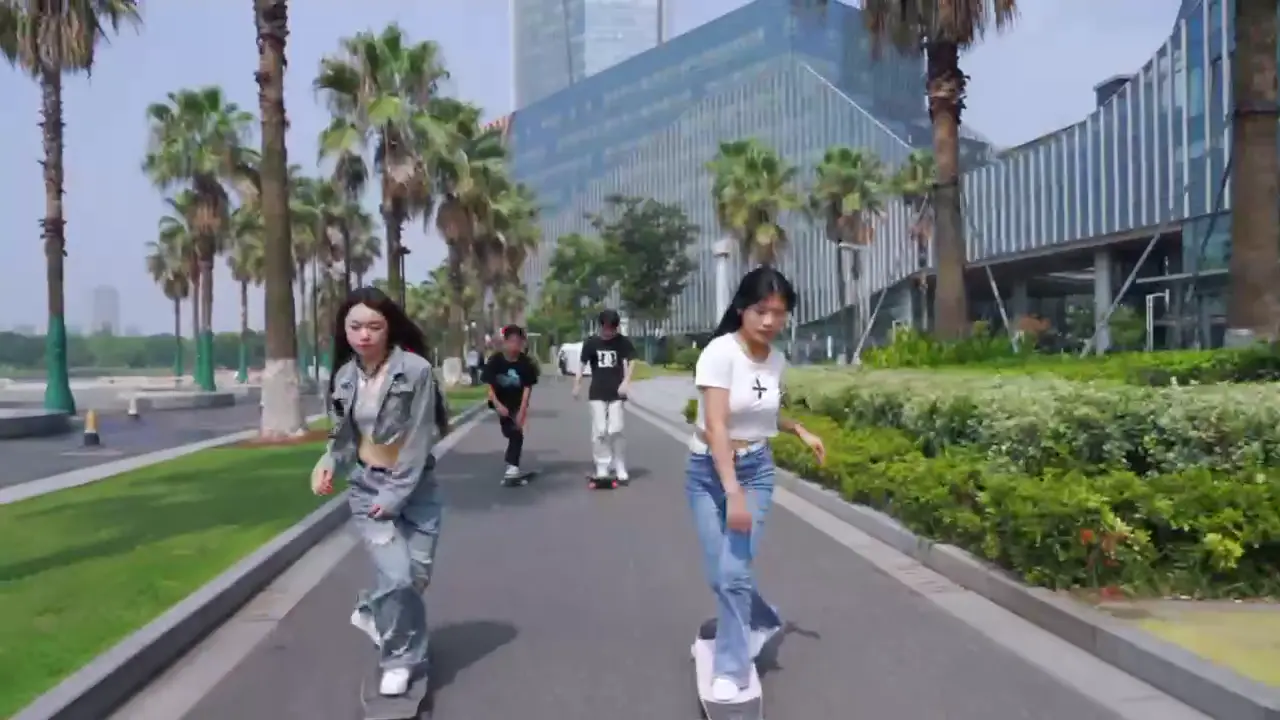
They also started a scene. They gathered the city's riders at Xicheng Square, then at Xihu Culture Square, then at the Jiubao bus terminal, Hangzhou's big coach station on the east side of the city, with acres of flat paving around it. Some nights more than a hundred people showed up.
Xiaomiao filmed herself riding and posted it. Her Meipai account peaked at 170,000 followers. A 2018 clip of her riding at Jiubao got nearly 500,000 likes and 4,700 comments. She is still in most of Nishan's videos.
"My parents always thought skating was for street boys," she has said. "But girls can skate too, and I want to change that."
Today seven in ten Nishan customers are women. Riders in Lolita dresses and Ming-style horse-face skirts show up in its videos all the time.
Building Nishan
Nishan was founded in 2014. For its first four years it sold imported boards: Loaded, Landyachtz, Rayne. That taught Ban Ya and Xiaomiao what riders bought, what broke and what people came back for.
On January 1, 2018, they launched their own brand, 逆山极限, Nishan Extreme. 逆山 means "reverse mountain": going uphill, against it.
"My brand is called Nishan," Ban Ya said. "It stands for the spirit of climbing."
He wanted a Chinese brand that owned everything it sold: "the design, the technology, the sales channels and the pricing."
The first Nishan boards came out that summer, and they were longboards. "Longboards are the easiest," Ban Ya said. "A beginner can ride one in fifteen minutes."
The first line, 以梦为鹿, Dream Deer, put the nine-coloured deer from the Dunhuang cave murals on a deck. In the old Buddhist tale the deer saves a drowning man, who later betrays it to a king. The design went through five rounds of drafts with illustrators from the China Academy of Art. The rejected sketches hang framed on the walls of Nishan's shops.
The Nishan series came next, with creatures from the Classic of Mountains and Seas, China's oldest book of myths: the black tortoise, the azure luan, the crane and the white fox. The crane and the fox are still in the line.
Making their own boards nearly broke them. Only one factory in China would take the job, in Dongguan, and it had never made anything but drift boards. Each mould cost ¥20,000, and samples came on top of that. For years the brand lost money. Chinese has a phrase for it: 交学费, paying tuition.
They kept their prices at about half what the imports cost, and in 2019 it paid off. One colourway of the ¥890 Nishan complete sold over a thousand sets, and monthly sales reached nearly ¥900,000. Jiumeng, a ¥730 line for teenagers, had parents posting reviews of the boards they bought their kids.
In 2018 Nishan became the first shop in China to import Yow, the Spanish surfskate brand. Ban Ya figured older riders wanted a sport that was "thrilling but gentle", and surfskating was it.
In 2022 surfskating blew up in China as a substitute for surfing and skiing. Nishan was ready for it.
"In 2022 we were number one for surfskates on Taobao," Ban Ya said, "and our sales that year passed ¥30 million."
They went on to design their own surfskate truck. Work on the Snake truck started in 2021, and after more than three years of testing it launched in 2025.
Champions at the counter
Nishan has two shops in Hangzhou, in Gongshu and Xiasha. To work in one you need a competition title and patience, and everyone who sells boards also coaches. The Gongshu manager is a street skater from Inner Mongolia with a stack of local titles. Another staff member is China's women's street skating champion. On the walls in Xiasha hang boards signed by Li Chen, Zhu Dan, Zhang Zhenyue and Ren Xianqi.
Nishan now sponsors more than a hundred riders across China and helps them grow their own followings. It has hosted or backed nearly three thousand events and employs about 150 people. Taobao named it one of its Top Ten Shopkeepers. In 2025, when Chanel needed riders for its playground in Hangzhou, it called Nishan.
On Voice of West Lake, Hangzhou's FM 105.4, Ban Ya talked about longboards and surfskates, how to start and who each suits. Then the host asked what every founder who turns a hobby into a business gets asked: does doing it for a living kill the love?
He has answered it in other interviews. "I have always felt responsible for pushing skating in China in a good direction," he said. "Make honest products, treat your customers right, and more and more young people will trust a Chinese brand."
Xiaomiao puts it in money terms: cheap Chinese manufacturing lowers the price of a good board, so more people get into the sport.
Ban Ya's first board was ¥90 of supermarket junk that broke in a month. Nishan's boards are drawn by artists, pressed in Nishan's own moulds and sold at about half the price of the imports, so a beginner today starts on a real board.
The motto from the Jiubao nights is still the company motto: 以板会友, make friends through boards.